Thesis Chapters by John Azabo

Azabo John Moses, 2020
This study examined the role of local government in service delivery in Luri County. The purpose ... more This study examined the role of local government in service delivery in Luri County. The purpose of the study was to assess the number of public services delivered in Luri County. The review of the related literature was solicited from the role of local government in service delivery, the challenges facing the local government in Service delivery and the strategies that the local government should use to improve service delivery.The research design was a crosssectional survey and the research methodology was both qualitative and quantitative in nature, the target population was obtained from the staffs Luri County Local Government and the residents of their residents. The total sample size was 45 respondents and derived through simple random non-probability sampling techniques, the instruments for data collection used was questionnaire which was used to obtain primary data. The data derived from the questionnaires was analyzed using the Statistical Package for Social Sciences (SPSS). Descriptive statistics used mainly to summarize the data. This included percentages and frequencies. Tables, graphs and pie charts used as appropriate to present the data collected for analysis and interpretations.The findings established that policies on service delivery on key sectors like roads and public works, agriculture, health, trade and water are available and operational; process of devolution of operations so far has been smooth, efficient and effective; and, national government is fully committed to ensuring devolution of operations is successful. The study recommends that more resources should be devolved so as to cater for the devolved functions of the county governments. A case in point is the capital intensive healthcare services that require huge financial and human resources in order to enhance its service delivery. Resource allocation should also look at the county endowment and disparity in resource availability. For instance, counties should receive a greater share of revenue the larger their population, the higher their poverty rate and the larger they are in terms of land mass.
Global Freelancers, 2021
ABSTRACT
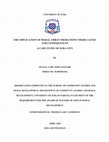
This study examined the impact of rural urban migrations their causes and consequences a... more ABSTRACT
This study examined the impact of rural urban migrations their causes and consequences a case study of Juba. The purpose of the study was to assess the implication, causes and consequences of Rural Urban Migration. The review of the related literature was solicited from major implications of Rural Urban Migration, the socio Economic and Socio demographic profile of the Migration, the Challenges of Migrants faced during their arrival in the town and the Consequences of In-Migration particularly on housing, employment and Social Conditions and other facilities and amen ties in the Study area. The research design was a cross-sectional survey and the research methodology was both qualitative and quantitative in nature, the target population was obtained from the staffs in the department of Rural-development and the residents of Juba. The total sample size was 50 respondents and derived through simple random non-probability sampling techniques, the instruments for data collection used was questionnaire which was used to obtain primary data. The data derived from the questionnaires was analyzed using the Statistical Package for Social Sciences (SPSS). Descriptive statistics used mainly to summarize the data. This included percentages and frequencies. Tables, graphs and pie charts used as appropriate to present the data collected for analysis and interpretations. Findings of the study was that, most migrants moved basically for economic reasons such as seeking employment, job transfer, to open up or extend personal business, to gain education and training services. On the other hand, some of them were moved to Juba for non-economic reasons such as to be free from cultural or family restriction and obligation, and to join relatives or friends in the town. The study recommended that regional re-integration to ensure balanced development, increased agricultural production in to boast economic livelihood in the rural areas, improvement in healthcare, education and other social amenities
Global Freelancers , 2021
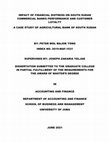
This study examines the Impact of Financial Distress On South Sudan Commercial Banks Performance... more This study examines the Impact of Financial Distress On South Sudan Commercial Banks Performance and Customer Loyalty, A Case Study of Agricultural Bank of South Sudan. The review of the related literature was solicited from the effect of liquidity on financial performance of commercial banks, effect of leverage on financial performance of commercial banks, effect of operating efficiency of the firm to performance of commercial banks, the extent to which asset quality affects the performance of commercial banks and examining the extent to which capital adequacy affects financial performance of commercial banks. The research design will be a cross-sectional survey and the research methodology will be both qualitative and quantitative in nature, the target population is obtained from the employees of Agricultural bank of South Sudan in Juba. The total sample size will be 100 respondents and derived through simple random non-probability sampling techniques, the instruments for data collection used was questionnaire which was used to obtain primary data. The data derived from the questionnaires was analyzed using the Statistical Package for Social Sciences (SPSS). Descriptive statistics used mainly to summarize the data. This included percentages and frequencies. Tables, graphs and pie charts used as appropriate to present the data collected for analysis and interpretations. The study found that, liquidity which was measured in terms of quick assets to total. The overall measure of liquidity was found to have a positive distressing effect on financial performance of Agricultural Bank of South Sudan. From the results of the analysis conducted by the study and hypothesis tested, it was concluded that liquidity as a distress factor has a positive significant influence on the financial performance of Agricultural Bank of South Sudan. This also means that commercial banks liquidity has a distressing effect to financial performance of Agricultural Bank of South Sudan. The study recommended that, Central Bank of South Sudan should ensure proper additional measures are put in place to counter the effect of financial distress factors that may affect financial performance of Agricultural Bank of South Sudan. CB as a regulator of commercial banks should re-adjust the regulation framework regularly. Agricultural Bank of South Sudan must strive to maintain proper levels of liquidity as lack of liquidity may bring about failure of meeting customer needs especially the depositors who form the largest chunk of a bank’s total liabilities.



Uploads
Thesis Chapters by John Azabo
This study examined the impact of rural urban migrations their causes and consequences a case study of Juba. The purpose of the study was to assess the implication, causes and consequences of Rural Urban Migration. The review of the related literature was solicited from major implications of Rural Urban Migration, the socio Economic and Socio demographic profile of the Migration, the Challenges of Migrants faced during their arrival in the town and the Consequences of In-Migration particularly on housing, employment and Social Conditions and other facilities and amen ties in the Study area. The research design was a cross-sectional survey and the research methodology was both qualitative and quantitative in nature, the target population was obtained from the staffs in the department of Rural-development and the residents of Juba. The total sample size was 50 respondents and derived through simple random non-probability sampling techniques, the instruments for data collection used was questionnaire which was used to obtain primary data. The data derived from the questionnaires was analyzed using the Statistical Package for Social Sciences (SPSS). Descriptive statistics used mainly to summarize the data. This included percentages and frequencies. Tables, graphs and pie charts used as appropriate to present the data collected for analysis and interpretations. Findings of the study was that, most migrants moved basically for economic reasons such as seeking employment, job transfer, to open up or extend personal business, to gain education and training services. On the other hand, some of them were moved to Juba for non-economic reasons such as to be free from cultural or family restriction and obligation, and to join relatives or friends in the town. The study recommended that regional re-integration to ensure balanced development, increased agricultural production in to boast economic livelihood in the rural areas, improvement in healthcare, education and other social amenities